THE MATRIX OF PARADIGMA
A Strategic Framework for Ethics, Legality & Business Sustainability


Beyond Compliance. Towards Integrity.
A Foundational Conceptual Publication
Developed by HumanKnowHow.org
Author: Lily Petkova
Translation: Български
PUBLICATION OVERVIEW
The Matrix of Paradigma is an original conceptual and strategic framework developed to explore the relationship between legality, ethical conduct, and long-term business sustainability.
At its foundation lies a fundamental proposition:
Legality and ethics are not the same thing.
A business decision may be entirely lawful while remaining ethically questionable. Conversely, an action may be motivated by moral principles while conflicting with existing legal requirements.
This distinction raises an important strategic question:
Is legal compliance alone sufficient to define a business as responsible, ethical, and sustainable?
The Matrix of Paradigma proposes an analytical approach that goes beyond formal legal compliance. It examines the relationship between legal permissibility, ethical legitimacy, and the long-term consequences of organizational decisions.
It is not merely a classification tool for business conduct. It is a conceptual foundation for understanding how organizations create value, establish trust, and manage the consequences of their decisions.
Traditional approaches to corporate responsibility often place legal and regulatory compliance at the center of evaluating appropriate business conduct.
However, law and ethics serve different functions.
Law defines the boundaries of what is legally permissible.
It establishes mandatory rules, restrictions, obligations, and consequences for non-compliance.
Ethics defines the quality of choice.
It raises questions concerning fairness, integrity, responsibility, transparency, and the treatment of other stakeholders.
Strategy determines the consequences over time.
It considers how present decisions influence trust, reputation, competitiveness, and organizational sustainability.
This leads to the central strategic proposition of The Matrix of Paradigma:
Legality determines whether an action is permissible under the applicable legal system. Ethics questions whether that action is right. Strategy examines the consequences of that choice over time.
The model uses a two-dimensional analytical matrix based on two independent dimensions:
-
Legality: ranging from unlawful to lawful conduct.
-
Ethics: ranging from unethical to ethical conduct.
The intersection of these dimensions produces four strategic quadrants.

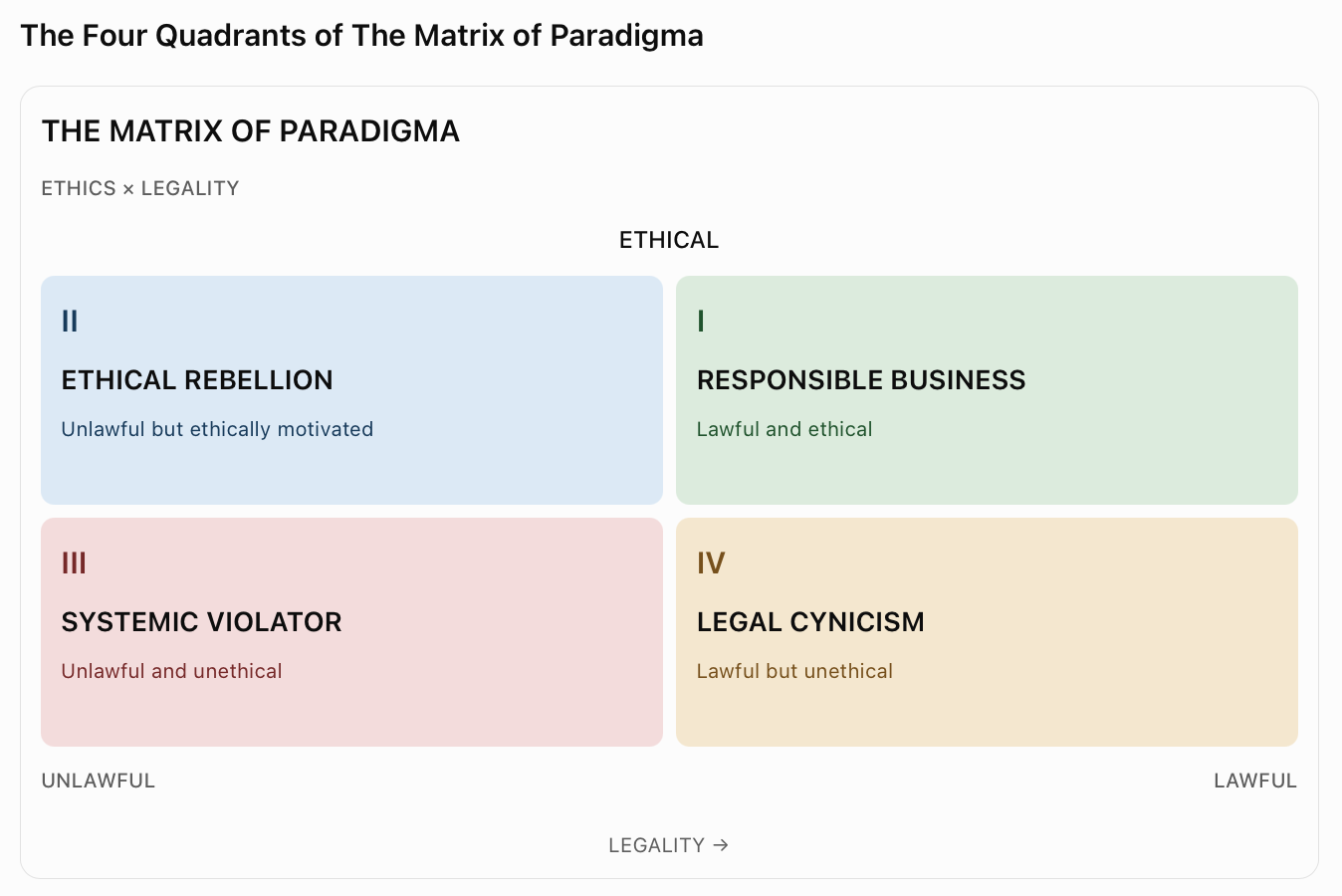
THE FOUR QUADRANTS
QUADRANT I — RESPONSIBLE BUSINESS
Lawful and Ethical Conduct
This quadrant represents organizations that not only comply with applicable laws and regulations but also operate in accordance with principles of integrity, fairness, transparency, and responsibility.
Key characteristics include:
-
Legal and regulatory compliance.
-
Ethical management practices.
-
Responsibility towards employees, customers, and society.
-
Transparency and trust-building.
-
A long-term sustainability orientation.
Strategic perspective: Building trust, reputational capital, and sustainable competitive advantage.
QUADRANT II — ETHICAL REBELLION
Unlawful but Ethically Motivated Conduct
This quadrant examines situations in which an individual or organization acts out of moral conviction or in defense of fundamental principles while conflicting with existing legal norms.
Potential examples include civil disobedience, moral resistance to unjust practices, and actions intended to challenge regulations or institutional arrangements perceived as unjust.
Key characteristics include:
-
Moral motivation.
-
Conflict between existing law and ethical convictions.
-
Challenges to established practices or rules.
-
Potential for social and institutional change.
Strategic perspective: Moral resistance and the potential transformation of an existing system.
An important qualification: ethical motivation does not automatically justify an unlawful action. Its assessment requires consideration of moral legitimacy, necessity, proportionality, and accountability for its consequences.
QUADRANT III — SYSTEMIC VIOLATOR
Unlawful and Unethical Conduct
This quadrant encompasses conduct in which an organization violates the law while simultaneously acting in contradiction to fundamental ethical principles.
Potential manifestations include:
-
Corruption and fraud.
-
Abuse of power or trust.
-
Systematic violations of rights.
-
Deliberate deception and manipulation.
-
Unlawful extraction of economic benefits.
Strategic perspective: Short-term exploitation accompanied by the accumulation of significant legal, financial, reputational, and organizational risks.
QUADRANT IV — LEGAL CYNICISM
Lawful but Unethical Conduct
This quadrant represents a particularly important focus of The Matrix of Paradigma.
It examines situations in which an organization operates within formal legal boundaries while using legally available opportunities in ways that conflict with principles of fairness, transparency, integrity, or social responsibility.
Potential manifestations include:
-
Exploiting legal loopholes to avoid responsibility.
-
Misleading contractual practices that remain formally lawful.
-
Taking advantage of information or economic asymmetries.
-
Aggressive business practices targeting vulnerable customers.
-
Withholding material information in circumstances where doing so does not constitute a formal legal violation.
Strategic perspective: Achieving short-term economic benefits while potentially accumulating long-term reputational, social, and strategic risks.
This quadrant highlights one of the central distinctions explored by the model:
Legal permissibility is not equivalent to ethical legitimacy.
3. THE COMPLEMENTARY STRATEGIC DIMENSION: BUSINESS SUSTAINABILITY
The Matrix of Paradigma does not treat legality and ethics as isolated characteristics.
They must also be examined in terms of their potential consequences for business sustainability.
For this reason, the concept introduces a complementary strategic dimension:
Business Sustainability.
This dimension considers the potential impact of organizational conduct on:
-
Financial sustainability.
-
Reputational capital.
-
Stakeholder trust.
-
Long-term competitiveness.
-
Resilience to legal, regulatory, and market risks.
Within the initial conceptual framework, Business Sustainability is not a third axis of the original matrix. It is an outcome-oriented dimension through which the strategic implications of an organization's position within the four quadrants can be examined.
This makes it possible to distinguish between two important questions:
How does an organization behave, and what consequences might that behavior have for its long-term sustainability?
4. THE FUNDAMENTAL DISTINCTION: COMPLIANCE VS. INTEGRITY
One of the central questions raised by The Matrix of Paradigma concerns the distinction between compliance and integrity.
Compliance refers to adherence to applicable laws, regulations, and mandatory requirements.
Integrity refers to consistent adherence to principles of honesty, ethical conduct, and responsibility, including in situations where the law does not explicitly require a particular course of action.
An organization may have a sophisticated compliance system while still engaging in practices that undermine the trust of its customers, employees, partners, and society.
Therefore:
Compliance can help prevent unlawful conduct, but it does not, by itself, guarantee an ethical organizational culture.
The Matrix of Paradigma seeks to make this distinction visible and encourage a broader approach to corporate governance and strategic decision-making.
5. THE DYNAMICS OF THE MATRIX: FROM CLASSIFICATION TO TRANSFORMATION
Organizations are not static systems. Their conduct evolves under the influence of leadership, corporate culture, market conditions, regulation, public expectations, and strategic priorities.
For this reason, The Matrix of Paradigma should not be used solely to determine an organization's position at a particular moment.
It can also serve as a framework for examining movement between the four quadrants over time.
Examples include:
-
From Legal Cynicism to Responsible Business: A transformation from formally lawful but ethically questionable conduct towards the integration of integrity into business strategy.
-
From Systemic Violator to Responsible Business: A comprehensive organizational and managerial transformation.
-
From Responsible Business to Legal Cynicism: A gradual departure from ethical principles while maintaining formal legal compliance.
This dynamic perspective enables the model to function not only as a diagnostic framework but also as a foundation for strategic organizational development.
The Matrix of Paradigma can serve as a conceptual and analytical framework across several areas.
Corporate Strategy
Evaluating the relationship between business decisions, ethical principles, and long-term value creation.
Corporate Governance
Examining management practices and leadership decisions beyond formal compliance requirements.
Organizational Culture
Understanding the behaviors an organization encourages, tolerates, or considers acceptable.
Risk Management
Identifying potential reputational, ethical, and strategic risks that may remain undetected by traditional compliance approaches.
Investment and Business Analysis
Providing a complementary perspective on business model sustainability and the nature of competitive advantage.
Education and Academic Research
Providing a basis for discussion, analysis, and empirical research in business ethics, corporate governance, and economic sustainability.
7. RESEARCH PERSPECTIVE
The Matrix of Paradigma is a conceptual framework with the potential to evolve into a more systematic analytical and quantitative model.
Its further development requires theoretical examination, methodological refinement, and empirical investigation.
To guide this process, the framework identifies five foundational research questions:
-
Is a high level of legal compliance sufficient to ensure a high level of ethical conduct?
-
How does lawful but unethical behavior affect stakeholder trust and reputational capital?
-
What is the relationship between ethical organizational culture and the likelihood of future legal violations?
-
How does the long-term sustainability of organizations change as they move between the different quadrants?
-
Can integrating legality and ethics into strategic management create measurable economic value?
These questions provide a foundation for developing additional analytical instruments, including indices, assessment methodologies, and comparative research models.
The Matrix of Paradigma is currently a conceptual framework under development. Its measurement criteria, operational definitions, thresholds, and proposed relationships require further methodological development and empirical validation.
8. RESEARCH AGENDA & PROPOSED HYPOTHESES
The research agenda of The Matrix of Paradigma is intended to encourage systematic investigation of the relationship between legal compliance, ethical conduct, organizational behavior, and long-term business sustainability.
The hypotheses below represent preliminary propositions for academic discussion and empirical examination. They are not presented as established or universally proven relationships.
| Code | Research Hypothesis |
|---|---|
| H1 | A high level of legal compliance does not necessarily guarantee a high level of ethical conduct. |
| H2 | Low levels of ethical conduct may generate long-term reputational risks, even when an organization maintains a high level of legal compliance. |
| H3 | The combination of high ethical and legal standards creates conditions that may support more sustainable stakeholder trust. |
| H4 | A strong ethical corporate culture may reduce the likelihood of future legal violations. |
| H5 | Organizations positioned in Quadrant IV (Legal Cynicism) may face a risk of strategic deterioration as public expectations and regulatory standards evolve. |
| H6 | A transition from Quadrant IV (Legal Cynicism) to Quadrant I (Responsible Business) may improve long-term business sustainability. |
Proposed Areas for Further Research
The hypotheses create opportunities for investigation in several interconnected fields:
1. Legal Compliance and Ethical Conduct
Examining whether and under what circumstances legal compliance corresponds with ethical organizational behavior.
2. Reputation and Stakeholder Trust
Investigating the relationship between ethically questionable but lawful business practices, stakeholder perceptions, and reputational outcomes.
3. Corporate Culture and Legal Risk
Exploring whether ethical leadership and organizational culture are associated with a lower incidence of legal violations.
4. Strategic Adaptability
Examining how organizations respond to changes in social expectations, regulatory environments, and standards of responsible business conduct.
5. Organizational Transformation
Investigating whether changes in organizational behavior from Legal Cynicism towards Responsible Business produce measurable improvements in business sustainability.
6. Measurement and Validation
Developing operational definitions, indicators, assessment methods, and research instruments capable of evaluating the two primary dimensions of the matrix and their relationship with business sustainability.
The research agenda may be expanded through interdisciplinary collaboration involving economics, business administration, law, ethics, organizational psychology, corporate governance, and sustainability research.
9. THE BROADER VISION: PARADIGMA
The Matrix of Paradigma represents a starting point for a broader conceptual system that may bring together the study of ethics, legality, and economic sustainability.
Over time, this system may include:
Paradigma Economic Theory
A potential theoretical framework for examining the interaction between ethics, legality, and economic behavior.
The Matrix of Paradigma
The principal analytical model for distinguishing between four categories of organizational conduct.
Paradigma Index
A prospective quantitative system for measurement and comparative analysis.
Paradigma Assessment
A practical methodology for evaluating organizations, business models, and management decisions.
These components represent a proposed direction for future development rather than a claim that each has already been fully developed and validated.
10. COLLABORATION & DEVELOPMENT
An Invitation to Research, Collaboration and Further Development
HumanKnowHow.org welcomes expressions of interest and invitations for academic, scientific, and institutional collaboration aimed at critically examining, researching, validating, and further developing The Matrix of Paradigma.
We are open to exploring partnerships with:
-
Universities and higher education institutions.
-
Academic researchers and independent scholars.
-
Research institutes and research centers.
-
Business schools and academic departments.
-
Think tanks and policy research organizations.
-
Corporate governance and business ethics organizations.
-
Public institutions and relevant international organizations.
-
Professional communities interested in interdisciplinary research and responsible business development.
Potential Areas of Academic Collaboration
Potential areas of collaboration include:
-
Theoretical examination and critical assessment of the framework.
-
Academic research and empirical testing of the proposed hypotheses.
-
Development of research methodologies and measurement indicators.
-
Comparative studies across industries, countries, and regulatory environments.
-
Further development and refinement of the four-quadrant model.
-
Investigation of the relationship between ethical conduct, legal compliance, and business sustainability.
-
Joint research projects, academic publications, conferences, and educational initiatives.
-
Exploration of the potential development of the Paradigma Index and Paradigma Assessment.
HumanKnowHow.org recognizes the importance of independent academic scrutiny, interdisciplinary perspectives, and constructive criticism in the development of a conceptual framework.
The objective is not simply to promote a new conceptual model, but to subject it to critical examination, strengthen its theoretical foundations, and investigate its practical and empirical relevance.
We welcome opportunities to exchange ideas, discuss research proposals, and explore mutually beneficial partnerships for the continued development of The Matrix of Paradigma.
Universities, research institutions, organizations, and interested experts are invited to contribute to this process.
Potential Practical Applications & Development
Beyond its academic and research potential, The Matrix of Paradigma may provide a foundation for the development of practical products, services, and professional applications.
Potential directions for future development may include:
-
Books and specialized publications.
-
Educational programs, professional training, and workshops.
-
Corporate assessments and organizational diagnostics.
-
Strategic consulting and advisory services.
-
Business ethics and corporate governance assessment tools.
-
The Paradigma Index and related analytical instruments.
-
Digital platforms and software solutions supporting organizational assessment and strategic decision-making.
These applications represent potential future development directions and may be pursued independently or in collaboration with relevant academic, institutional, and business partners.
.
11. CONCLUSION
Business does not exist solely within the boundaries of law. It also exists within a broader framework of social relationships, moral expectations, trust, and the consequences of organizational decisions.
Legality is fundamental. However, it is not the only criterion for responsible business conduct.
Ethics matters not only when the law is silent, but also when the law allows organizations to choose between different courses of action.
Business sustainability should not be understood solely as the ability to generate economic results. It should also involve the ability to create value in a way that preserves trust and responsibility over time.
The Matrix of Paradigma raises a question beyond whether a business follows the rules: what kind of business does it create through its decisions?
Ultimately: Legality defines the boundaries. Ethics defines the choice. Strategy defines the future.
THE MATRIX OF PARADIGMA
Beyond Compliance. Towards Integrity.
Contact & Collaboration
For research inquiries, academic cooperation, partnerships, and further development of The Matrix of Paradigma, please contact:
HumanKnowHow.org
Email: info@humanknowhow.org
INTELLECTUAL PROPERTY & PUBLICATION INFORMATION
Title: The Matrix of Paradigma – A Strategic Framework for Ethics, Legality & Business Sustainability
Work Type: Original Conceptual Framework / Strategic Analytical Model
Developed by: HumanKnowHow.org
Author: Lily Petkova
Publication Date: 9 November 2026
Version: 1.1 – Foundational Conceptual Publication
Language: English
Copyright Notice: © 2026 HumanKnowHow.org. All rights reserved.
Reproduction, distribution, adaptation, or commercial use of protected elements of this work must comply with applicable intellectual property laws and the terms established by the relevant rights holders.
This publication is intended for informational, educational, and conceptual purposes. It does not constitute legal, investment, or audit advice.